


Previous chapter / Start at the beginning
Walter paid little attention to the arrival and departure of the 737 flights in Terrace, but on this occasion he was watching for a particular passenger – Trish’s brother, Richard. Trish had said her mother had written to let her know Richard was coming to stay for a few weeks. Like Walter, Trish didn’t get vacation time, so she would be working the entire time her brother visited. Not only that, she lived in the Nurse’s Station in Telegraph Creek. It had guest rooms for visiting doctors, but they weren’t intended for personal visitors. Still, Richard was on his way, and she had told Walter she would manage.
When Richard arrived in Terrace, Walter recognized him from Trish’s description and greeted him. He invited him to sit up front for the flight into Telegraph Creek, then wished him a pleasant visit after dropping him off. He wondered what Richard would find to do in such a small community while Trish worked.
Shortly after, Walter had his own unexpected visitors. When the 1972 school year ended, Walter got a call from his mother. His youngest brother, Bobby, had broken his arm playing rugby and was in a cast. She thought spending the summer in Terrace would be a safe place for him to rest and recuperate. She said Bobby was willing to go and had asked if he could bring his friend Mark along for company. Walter glanced around the cabin, it would be a squeeze, and the accommodations were certainly far rougher than either boy was used to, but he agreed.
The boys arrived. They were in their mid-teens and, like Walter, decided that the beach at the cabin’s front door made up for any shortcomings. They spent most days on the beach or in the water. Bobby dutifully tied a plastic bag around his cast before swimming, but it was less than effective; most times, the bag filled with water. It wasn’t long before the cast was in bad shape, but that didn’t slow him down.
Occasionally, when Walter flew a charter from the dock at the lake, he invited the boys to come along. They always jumped at the chance. One day, Di assigned Walter to shuttle freight between Stewart and Snippaker Creek. There was a mining site up in the hills above Snippaker Creek, but nowhere for a plane to land. Instead, Walter would fly the cargo into Snippaker Creek, and a helicopter would shuttle it up to the camp from there. It would involve multiple flights to and from Stewart to move all the cargo. The boys wanted to go along, but Walter thought they’d get bored. Then he remembered he’d bought each of them a gold pan when he had learned of their visit, so he handed them over, packed lunches, and they headed out for the day.
The boys flew with him in the Otter up to Stewart and watched as a few guys loaded a large amount of freight. When they were done, the load filled the back of the plane, so the boys climbed on top of it, lying on their bellies, squeezed into the gap between the freight and the deckhead, for the flight down to Snippaker Creek. Once Walter had landed on the creek bed, the boys crawled down from their roost atop the cargo, and enthusiastically set off up the creek, gold pans and lunches in hand. Walter spent the rest of the day shuttling freight between Stewart and the creek bed at Snippaker, an eighty-mile flight each way. Several hours later, when he landed with the last load of cargo, the boys emerged from the brush along the creek – hungry, empty-handed, but full of stories of their day. It didn’t occur to Walter until later that it might have been risky to send two city kids, one with a broken arm, into remote wilderness with nothing more than sandwiches and a gold pan. Not to mention what would have happened if something had gone wrong with the plane during the day, and Walter would have been delayed. It had turned out fine, though, and the boys were pretty excited about it.
Before they returned to Kelowna, Walter took them along on another memorable flight. Occasionally, TransProvincial did what were called “OCS” flights – On Company Service. These were generally done as favours, not charters. Walter was asked to fly an OCS flight the afternoon Ron Well’s daughter got married. Ron wanted Walter to fly the newly-weds over to the Queen Charlotte Islands after the reception. Walter agreed, and brought the boys along.
It was late when they set off, and the weather was terrible. Walter flew down the Skeena, and then out across the Hecate Strait. The weather was really below marginal. He kept calling the radio operator on the Charlottes, who insisted the ceiling was unlimited – no clouds, completely clear. Walter was still in awful weather but trusted the report. Then suddenly, the plane popped out of the cloud – boom. One moment everything was pitch black; the next, everything was glowing golden. The sun had just set across the Pacific, and the ocean looked like molten metal. A slow swell rolled below, the Queen Charlottes stood as a black silhouette, and the sky was layered with colour. Walter sat in awe. Beside him, Bobby stared in silence.
Walter landed, and realized the young couple hadn’t even noticed the spectacular view, lost as they were in each other. After dropping them off, Walter turned around to go back to Terrace. He knew what weather awaited them. He decided to return via the Douglas Channel rather than the Skeena, because it was wider and easier to navigate. By then, it was fully dark, still raining, clouded-in – horrible weather – but they made it back to Terrace. They talked about that sunset for days. Walter had never seen anything like it before, and of course, he didn’t have his camera. Even if he had, he thought, cameras don’t capture that kind of beauty. The image was imprinted in their minds, not on paper.
The day came for the boys to return to Kelowna. It had been a good visit. Walter wondered what their mother would think of the state of Bobby’s cast – by then it was little more than grubby strips of gauze. She later told him that when Bobby went to have it removed, the doctor hadn’t needed to cut it off; he simply unwrapped it.
When Walter next spoke to Trish, she told him Richard liked Telegraph Creek and had decided to stay. He was living in one of the guest rooms in the Nurse’s Station. Not long after, since nothing had been mentioned about Richard occupying one of the guest rooms, Walter arranged an overnight visit in Telegraph Creek. With Di’s help, the schedule was organized so he ended his day there and could stay. Trish cooked dinner for Walter and Richard, and they visited well into the evening. Richard was pleasant and seemed to genuinely enjoy life there.
Walter stayed in the second guest room and returned to Terrace in the morning. He knew he couldn’t count on that kind of flexibility often, but he watched for opportunities. He was becoming very aware that a pilot’s life wasn’t conducive to a relationship, let alone a family. His mind often wandered to his property in Southbank, and building a home there – a more settled, peaceful life.
With these thoughts in mind, the next time Trish was in Terrace and Walter could meet with her, he asked her to marry him. She agreed. They were now in entirely unfamiliar territory. They chose a wedding date – January 27, 1973 – and that was that. Trish went back to Telegraph Creek, and Walter kept flying. He asked Stuart to stand as his best man, and Stuart enthusiastically agreed.
As autumn arrived and the days grew shorter, Walter wondered what winter would bring for flying in the region. He was already getting a taste of it. Increasingly, he found himself having to overnight in one of the sked communities because of weather. One place where he was stranded several times was Cassiar. Its main industry was an asbestos mine. The runway sat downwind of the tailings pile, while the town was upwind. On the mornings after an overnight there, Walter would return to his plane and find it looking like a sheep sitting on the runway. If there was any moisture in the air – dew or rain – the asbestos fluff blowing off the tailings pile would stick to the aircraft. Walter kept a brush in the plane for those mornings where the coating was especially thick, and he would clean it up a bit before takeoff.
Another day, he took the Otter to Iskut to drop off cargo, and the weather closed in over Terrace, preventing his return. People in Iskut who wanted to get to Highland Post, and various other places, and Walter did what would have been expected at Buffalo – he took them. His new employers, however, were not impressed. Their charter license required flights to originate from their base in Terrace, and Walter knew that. TPA had scheduled service to Iskut, and an agent there, Jack Black – owner of the Black Market, amusingly – but they weren’t permitted to originate charters from Iskut. So Walter was flying “bootleg” charters. Nobody else had a base there, so he wasn’t actually encroaching on anyone; it just wasn’t how things were supposed to work. Walter’s mindset had always been that rules are not there to destroy you – they were there to challenge you.
When he finally returned to Terrace, the Otter was slightly overdue for its 50-hour inspection, after all the extra flying he’d done while he was waiting for the weather to open up in Terrace. Di let him know that he’d stirred things up, but Walter still didn’t meet with a manager. By then he sensed that Di truly went to bat for the pilots. Management rarely got past her with complaints; she decided what she was going to pass on. Many pilots called her “Mother Hen”. They could count on her completely.
The cabin at the lake proved wholly unsuitable for cold weather. With gaps between the logs, it was impossible to heat. Walter began looking for better accommodation and was pleased to hear of another cabin available at the lake, on the other side of the floatplane dock. It was much more weatherproof, though it had a flat roof that leaked regularly. Even so, it was an upgrade and Walter moved in right away.
As more rain and snow fell, especially in the higher elevations, the still-under-construction Stewart-Cassiar highway became impassable more often. When that happened, TransProvincial was chartered to fly the Greyhound bus route to Stewart using the DC-3. Since Walter had his instrument rating, he often flew as second seat. He didn’t mind; it was something different. Usually the route only took half a day, and he would return to his charter flights in the afternoon. Other times, they had a longer contract, and he was scheduled on the DC-3 for a few weeks at a time. When passenger numbers exceeded a certain limit, a flight attendant was required. Because the work was sporadic, that role fell to Bonnie, the daughter of one of the owners. She delighted in the job, and was rarely without a wide grin.
On one flight, as they were flying through cloud approaching Stewart, a passenger asked her, “Do you know where we are?”
Bonnie peered out the window, then said cheerfully, “I don’t have the faintest idea.”
Walter, who always worked hard to make his flights as routine as possible – after all, his passengers had booked transportation, not adventure – couldn’t imagine a less reassuring answer. Her coffee service was also amusing. She served one cup at a time from a little metal tray. Each time she returned for the next cup, always with a big smile, she’d hold the tray by the edge, dribbling coffee onto the passengers all the way up the isle. She was thoroughly entertaining and seemed completely unaware of it.
Despite occasional stints on the DC-3, Walter continued flying the sked. During scheduled stops in Telegraph Creek, he managed short visits with Trish, and occasionally longer ones with Di’s help. Walter approached the pastor at the Mennonite Church in Terrace to ask if he would conduct their wedding ceremony. The pastor had hesitated – Walter was an infrequent attendee, his schedule leaving little room for regular churchgoing. Walter’s family also wanted to meet Trish, but arranging a visit was difficult since Trish didn’t get any more days off than Walter did. Walter delayed confirming a date with his family. Trish had sent a letter of resignation to her employer. She – and her brother Richard – would leave Telegraph Creek in December, just before Christmas. She and Walter would spend Christmas together, and she would finally have time to plan the wedding. Walter hoped he could arrange the family meeting then.
In the meantime, life and work continued. Walter had a growing admiration for Trish’s work. There was a steady flow of medical cases requiring transfer to Terrace, and the day after Halloween was no exception. Di had told him to expect a stretcher patient out of Telegraph Creek. When he arrived, there was indeed a young girl in a basket stretcher, her leg splinted from ankle to hip, along with another patient who had a fractured leg. Trish must have had a busy night, setting broken bones, and preparing patients to be transferred out in the morning. Walter admired her capability in such a remote setting.
He also quickly learned how much small details matter when transferring stretcher patients. He secured the basket stretcher against the side of the Otter, and turned on the Janitrol heaters to keep the patient warm. Not long into the flight, a passenger came up front and said he had brushed against the metal handle of the basket stretcher – and it was red hot. The stretcher’s corner was touching the heater, and the aluminum tubing that formed the frame of the stretcher had conducted the heat, it was hot as heck. Walter shut the heater off immediately and added that to his growing list of things to consider on winter medical evacuations. The patient hadn’t mentioned it, but she must have been getting very uncomfortable.
Walter began asking around for an apartment or suite in Terrace where Trish, Richard, and Trish’s new puppy, Waldo, could live until the wedding. Ken Meyer, one of the senior pilots, had a basement suite available, and was happy to rent it to Walter. Ken himself had been married only recently, and Walter had heard a story about his wedding day. Apparently, on the morning of his wedding, Ken had received a call from Di telling him she had a charter he needed to fly.
“I was hoping for the day off,” Ken had said.
Di insisted the charter was important.
“Well, I guess we can postpone the wedding,” he’d replied after a pause. That jogged Di’ memory – he was getting married that day. She told him to have a lovely wedding, and she found another pilot.
Walter found the story amusing, but not surprising. The pilots had almost no personal time, they were often needed even on Sundays. Still, he hoped to avoid such a situation on his own wedding day, so he talked to Di to make sure he wouldn’t be scheduled for January 27th.
He had not yet confirmed the pastor who would conduct the ceremony. The pastor from the Mennonite church said he would be out of town on January 27th but would do it if they moved the date. Walter had no way to reach Trish – there was no phone at the Nurse’s Station – and he wasn’t willing to change the date without her. Instead, he worked with the pastor to find another solution. The Mennonite church was available if they could find another minister. Walter approached the Lutheran pastor, with whom he had even less of a relationship, and the Lutheran pastor agreed to perform the ceremony in the Mennonite church. It was unconventional, but confirmed.
Christmas was approaching, and so was the day Walter would bring Trish and Richard to Terrace. The night before they were scheduled to fly down on the sked, a storm closed in. Normally, when storms covered the area, sked flights were cancelled until conditions improved. Walter hoped this wouldn’t be necessary. His heart sank in the morning. Visibility was terrible, and snow was falling heavily. He went to the airport anyway, hoping for a break. Even if he couldn’t fly the sked, maybe he could slip into Telegraph Creek for Trish and Richard. But there was no break, and the forecast was grim. Day after day the storm sat over the region. A few times it lightened slightly over Terrace, and Walter attempted a landing in Telegraph Creek, but the approach was too difficult for the conditions. More than a week passed, and Walter grew more anxious.
Adding to his stress was the family visit he’d agreed to, the introduction between Trish and his family, that was scheduled in early January. He hadn’t been able to tell Trish, so the news would come as a surprise with very little notice. His family planned to meet in a motel in Topley, three-and-a-half hours south of Terrace. He looked forward to seeing them but felt uneasy about springing the visit on Trish.
Finally, conditions improved, and Walter could fly the sked. He stopped in Telegraph Creek and greeted Trish briefly, though she was occupied with meeting the new nurse arriving to replace her. Walter left her to it and returned later for her, Richard,Waldo and the other passengers.
Once they were settled in Ken’s basement suite, he told Trish that in two days they were expected in Topley to meet his family. She was caught off guard, but agreed to go. She expressed worry about being behind on wedding planning after the storm. Walter mentioned her concerns to Di, who immediately stepped in and helped however she could.
Walter booked motel rooms for himself and Trish; his family booked theirs. Walter and Trish arrived first and settled in. The visit went as well as it could, if a bit awkward, and Walter was pleased that Trish immediately connected with Shirl, John’s wife. Introductions with the others were somewhat stiff, but the circumstances were unusual. They visited through the afternoon and parted the next morning after breakfast. Back in Terrace, Trish plunged into wedding planning, while Walter returned to flying. Their evenings were full – meeting with the pastor, introducing Trish to Stuart, and meeting her friends, including Roger, a doctor at the hospital who helped plan the reception.
The day before the wedding, Walter’s family arrived in town. Even his Uncle Henry traveled from Alberta. His nieces and nephews were dressed up and excited. Walter was glad Richard was there – he felt a little guilty that he was surrounded by his own family while Trish’s family was too far away to attend.
Walter had only ever seen Trish in practical clothing suited to rough work conditions. He was taken aback to see her arrive at the church in a floor-length white gown with a fur-trimmed hood. She looked lovely.
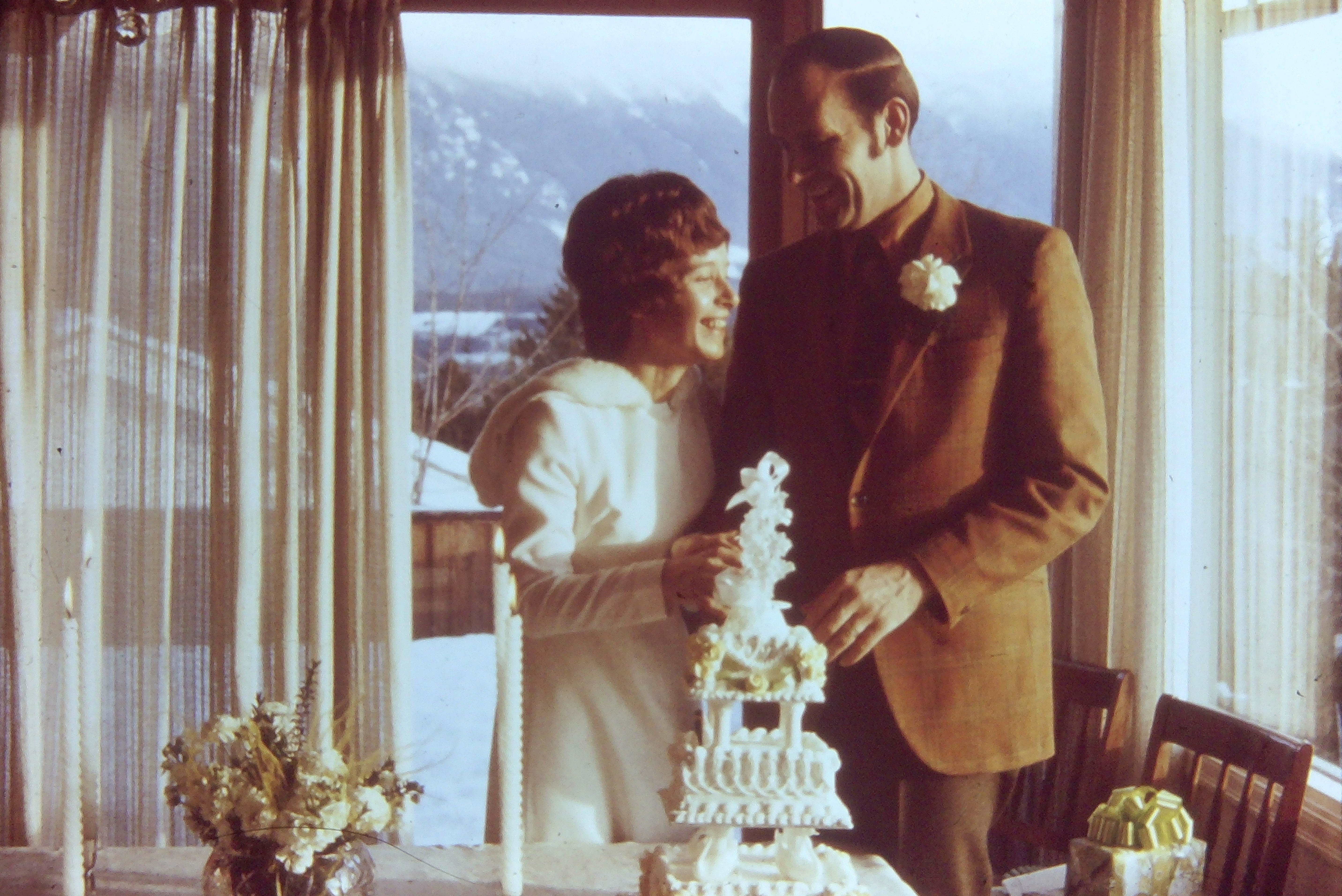
A year earlier, marriage had been far from Walter’s mind. Now he was ready to begin another new chapter – this time as a married man.
THE END
Previous chapter / Start at the beginning
Walter continued to fly for TransProvincial for several more months before resigning. He took work as a millwright at a local sawmill, and after the birth of their first child, he and Trish moved to Southbank. There, they established a small farm, and Walter began a new career on an inland ferry system.
If you enjoyed reading Walter’s story, please consider supporting my work by buying me a coffee.
Coffee makes the world go round, and the words flow, as they say!
If you have not yet read Trish’s story, you can find it here:
There is always so much going on in every chapter! I love how you relay the complications every step of the way to your parents getting married, but love wins out! 😍